

Public Statement on Omne Datum Optimum (1139)
**Public Statement on Omne Datum Optimum (1139) and the Historical Authority of the Templar Tradition**
Issued in a spirit of historical clarity, ecclesiastical respect, and academic responsibility
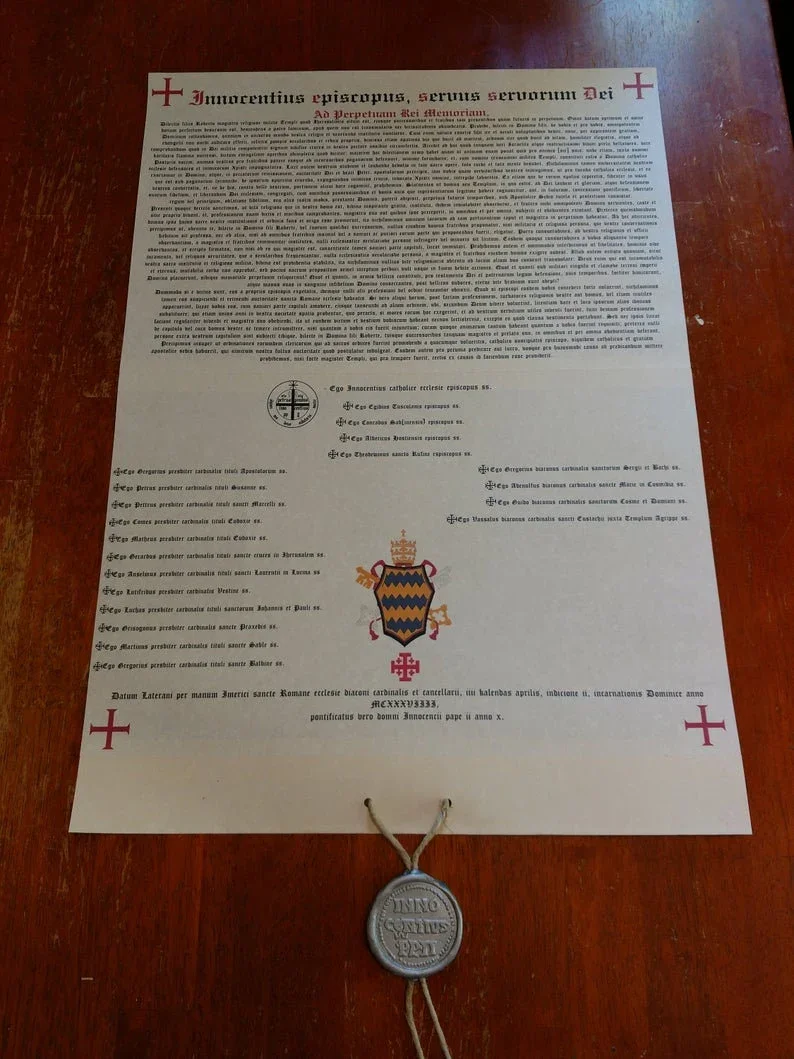
The papal bull Omne datum optimum, promulgated by Pope Innocent II on 29 March 1139, constitutes one of the most significant juridical instruments in the history of the medieval religious-military orders. By this solemn act, the Holy See granted the Poor Fellow-Soldiers of Christ and of the Temple of Solomon a defined body of ecclesiastical privileges, including direct subjection to the Roman Pontiff, exemption from local episcopal authority, and protections necessary for the fulfillment of their mission in defense of Christendom and service to pilgrims.
It is a matter of verifiable historical and canonical record that Omne datum optimum was subsequently confirmed and reinforced by later pontiffs, notably through the bulls Milites Templi (1144) and Militia Dei (1145). These confirmations demonstrate a continuity of papal intent and authority with respect to the Order during its medieval existence.
Equally, it must be stated with precision that no papal bull, conciliar decree, or juridical act has ever explicitly annulled, repealed, or revoked Omne datum optimum. This is not an interpretive assertion but a documentary fact. The suppression of the Order of the Temple in 1312 by Pope Clement V, through the bull Vox in excelso, was effected as an act of apostolic governance under extraordinary political circumstances and did not constitute a doctrinal condemnation, judicial sentence, or revocation of earlier papal privileges. The bull expressly avoided adjudicating guilt or heresy and made no reference to the annulment of prior papal instruments.
In the framework of historical canon law, suppression of an ecclesiastical body does not retroactively invalidate the lawful acts by which it was constituted or privileged. Rather, such privileges are rendered inoperative or dormant due to the cessation of the juridical subject, unless and until they are expressly withdrawn by competent authority.
Accordingly, contemporary references to Omne datum optimum must be understood within this precise legal and historical context. The bull remains an intact and unrepealed papal document of record. Any discussion concerning the continuity, revival, or moral authority of the Templar tradition in the present day necessarily involves questions of historical succession, ecclesial legitimacy, and recognition, which extend beyond the mere existence of the bull itself.
Bodies that identify with the spiritual and chivalric heritage of the Temple, including the Ordre du Temple de Jérusalem, affirm their commitment to approaching this legacy with historical honesty, ecclesiastical respect, and restraint, acknowledging both the enduring significance of Omne datum optimum and the limits of its modern juridical application absent explicit contemporary papal determination.
This statement is offered not to advance controversy, but to promote clarity, accuracy, and responsible discourse in matters touching upon Church history, canon law, and the enduring moral heritage of the chivalric vocation.
