Who Are the “Real” Knights Templar?
Examining the Historical, Masonic, and Modern Claims to Templar Heritage
Few names in history evoke as much fascination, mystery, controversy, and enduring interest as the Knights Templar.
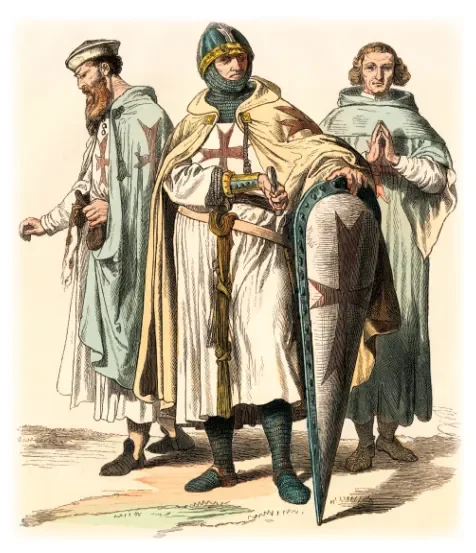
The white mantle. The red cross. The Crusades. The fall of Jerusalem. The trials in France. The death of Jacques de Molay.
For more than seven centuries, countless organisations have claimed to preserve the spirit, traditions, authority, or succession of the famous warrior-monks of the Temple. Yet when someone declares, “I am a Knight Templar,” what exactly does that mean?
The answer is far more complex than many realise.
The Original Knights Templar
The medieval Poor Fellow-Soldiers of Christ and of the Temple of Solomon were founded in Jerusalem around 1119. Recognised by the Church and answerable directly to the Pope, they became one of the most powerful religious-military orders in Christendom.
For nearly two centuries, the Templars defended pilgrims, fought in the Crusades, constructed fortifications, managed extensive estates, and developed financial systems that would influence medieval Europe. Their influence stretched across the Christian world, from the Holy Land to England, France, Spain, and beyond.
Their dramatic downfall began in 1307 when King Philip IV of France ordered the arrest of Templars throughout his kingdom. Following years of political pressure and ecclesiastical proceedings, Pope Clement V formally suppressed the Order in 1312.
As a recognised religious-military institution, the Order of the Temple ceased to exist.
Yet the Templar legend refused to die.
The memory of the Order would survive long after its suppression and inspire generations across Europe and beyond.
The Napoleonic Revival and the Ordre du Temple
Nearly five centuries after the suppression of the medieval Order, Europe witnessed a remarkable revival of interest in Templar traditions.
In France, Bernard-Raymond Fabré-Palaprat emerged as the leading figure of a revived Ordre du Temple. His claim rested upon the controversial Larmenius Charter, a document allegedly preserving an unbroken succession of Templar Grand Masters from Jacques de Molay to the modern era.
Under the influence and patronage available during the Napoleonic period, the revived Order gained considerable prominence. Its membership included military officers, clergy, aristocrats, and intellectuals.
From this revival emerged many of the non-Masonic Templar organisations that exist today, including branches of the Ordre du Temple de Jérusalem (OTJ).
Supporters view the movement as the restoration of an ancient Christian chivalric tradition. Critics argue that no universally accepted historical evidence demonstrates an uninterrupted legal continuation of the medieval Order.
Regardless of one’s position, the Napoleonic revival remains one of the most significant events in the history of modern Templarism and continues to influence numerous contemporary Templar organisations.
The Templar Legacy Within Freemasonry
While Christian revivalists were restoring Templar traditions in France, another development was taking place within Freemasonry.
By the eighteenth century, Masonic thinkers and ritualists had become fascinated by the symbolism and ideals associated with the Knights Templar. Templar themes began appearing throughout various systems of higher-degree Freemasonry.
Within these systems, the Templar was transformed from a medieval crusader into a moral, spiritual, and philosophical archetype representing fidelity, sacrifice, honour, and devotion to truth.
This development produced several distinct traditions that continue to influence Freemasonry today.
The Rite of Strict Observance
One of the most influential of these traditions was the Rite of Strict Observance, founded by Baron Karl Gotthelf von Hund.
The Strict Observance boldly claimed that Freemasonry itself descended from secret surviving Templars who had escaped persecution following the suppression of the medieval Order. According to its teachings, hidden Templar superiors secretly guided the Craft through the centuries.
The concept captivated eighteenth-century Europe. Nobles, princes, military officers, and scholars joined its ranks.
Yet the system eventually encountered a fundamental challenge.
Where were these hidden superiors?
As demands for evidence increased, the inability to substantiate these claims led the system into crisis and prompted a profound reassessment of its foundations.
The Rectified Scottish Rite and the CBCS
The turning point arrived at the Convent of Wilhelmsbad in 1782.
There, leading Masonic thinkers undertook a major reform of the Strict Observance. Rather than maintaining literal claims of direct Templar succession, they transformed the system into a more explicitly Christian and spiritual path.
The result was the Rectified Scottish Rite.
At its highest level stands the Order of the Chevaliers Bienfaisants de la Cité Sainte (CBCS), or Beneficent Knights of the Holy City.
The CBCS retained Templar symbolism and chivalric ideals but redirected them toward Christian virtue, charity, personal regeneration, and service to humanity.
Many Masonic scholars regard the Rectified Scottish Rite as one of the most sophisticated reconciliations of Templar mythology and Christian spirituality ever developed within Freemasonry.
Today, bodies such as the Great Priory of Belgium continue to preserve and administer this remarkable tradition.
The Ancient and Accepted Scottish Rite
Another major branch of Freemasonry also absorbed significant Templar influences.
The Ancient and Accepted Scottish Rite, practised throughout much of the world, contains numerous degrees inspired by Crusader history, Christian knighthood, and Templar symbolism.
Contrary to popular belief, the Scottish Rite does not claim to be a Templar Order, nor does it assert direct succession from the medieval Temple.
Nevertheless, the influence of Templar ideals is unmistakable throughout many of its higher degrees.
Themes of fidelity to truth, defence of faith, sacrifice, moral courage, resistance to tyranny, and Christian knighthood appear repeatedly within its teachings.
Particularly notable are the Eighteenth Degree, Knight Rose Croix, and the Thirtieth Degree, Knight Kadosh.
The Knight Kadosh degree developed from earlier Templar-inspired traditions and became one of the most recognisable expressions of Templar symbolism within the Scottish Rite. While interpretations vary among jurisdictions, the degree presents the image of the knight who stands for justice, honour, integrity, and the defence of truth against corruption and oppression.
Although the Scottish Rite is not itself a Templar Order, it preserves some of the most influential Templar-inspired teachings found anywhere in modern Freemasonry.
The Masonic Knights Templar
Alongside the Scottish Rite developed another distinct tradition: the United Religious, Military and Masonic Orders of the Temple and of St John of Jerusalem, Palestine, Rhodes and Malta.
These Orders represent the most direct and visible expression of Christian Templarism within regular Freemasonry.
Importantly, their legitimacy does not depend upon proving uninterrupted medieval succession.
Their authority derives from recognised Masonic constitutions, centuries of ritual development, and mutual recognition among sovereign Great Priories throughout the world.
They preserve Christian chivalry through ceremony, fraternity, charity, devotion, and moral instruction while openly acknowledging their Masonic origins.
This distinction is frequently overlooked. These Orders do not generally claim to be the medieval Knights Templar. Rather, they are Christian Masonic Orders inspired by the medieval Templar tradition and dedicated to preserving its ideals within a recognised Masonic framework.
The Modern Neo-Templar Movement
The twentieth and twenty-first centuries have witnessed a remarkable proliferation of organisations claiming Templar heritage.
Some are serious Christian chivalric orders. Others are charitable associations, initiatic societies, historical revival movements, ecclesiastical organisations, or explicitly Masonic bodies.
Still others combine elements of Templarism, Rosicrucianism, Martinism, esotericism, nobiliary traditions, or self-created systems of honours and titles.
This diversity makes careful historical analysis essential.
Not every modern Templar organisation is fraudulent, but neither are all claims equivalent.
The critical question is not who wears a red cross or adopts Templar symbolism. Rather, it is necessary to examine the basis upon which legitimacy is claimed.
Such claims may rest upon:
Historical succession
Spiritual succession
Constitutional succession
Masonic regularity
Christian service
Charitable activity
Initiatic lineage
Organisational continuity
Understanding these distinctions is fundamental to any serious study of modern Templarism.
The Enduring Legacy of the Temple
Perhaps the greatest misconception surrounding the Templars is the belief that there must be a single legitimate heir to the Templar legacy.
History suggests a more nuanced reality.
The medieval Order may have disappeared as a legal and ecclesiastical institution, yet its memory flowed into numerous streams:
Christian chivalric revivals
Napoleonic Templar restorations
The Rectified Scottish Rite
The CBCS
The Ancient and Accepted Scottish Rite
Masonic Knights Templar Orders
Charitable and devotional Templar organisations
Modern neo-Templar movements
Each preserves a different aspect of the Templar inheritance.
Some preserve history. Others preserve symbolism, spirituality, fraternity, Christian knighthood, or charitable service.
Consequently, the most meaningful question may not be, “Who are the real Knights Templar?”
Rather, it may be:
How has one of history’s most powerful ideals continued to inspire humanity across more than eight centuries?
The enduring fascination with the Templars is not ultimately rooted in hidden treasure, secret conspiracies, or romantic legends. It lies in the continuing appeal of the values the Templar image has come to represent: faith, honour, sacrifice, courage, service, and brotherhood.
Across the centuries, those ideals have proven remarkably resilient, finding new expressions in religious, chivalric, Masonic, charitable, and cultural movements around the world.
The story of the Knights Templar did not end in 1312. In many respects, it continues to be written today.
